
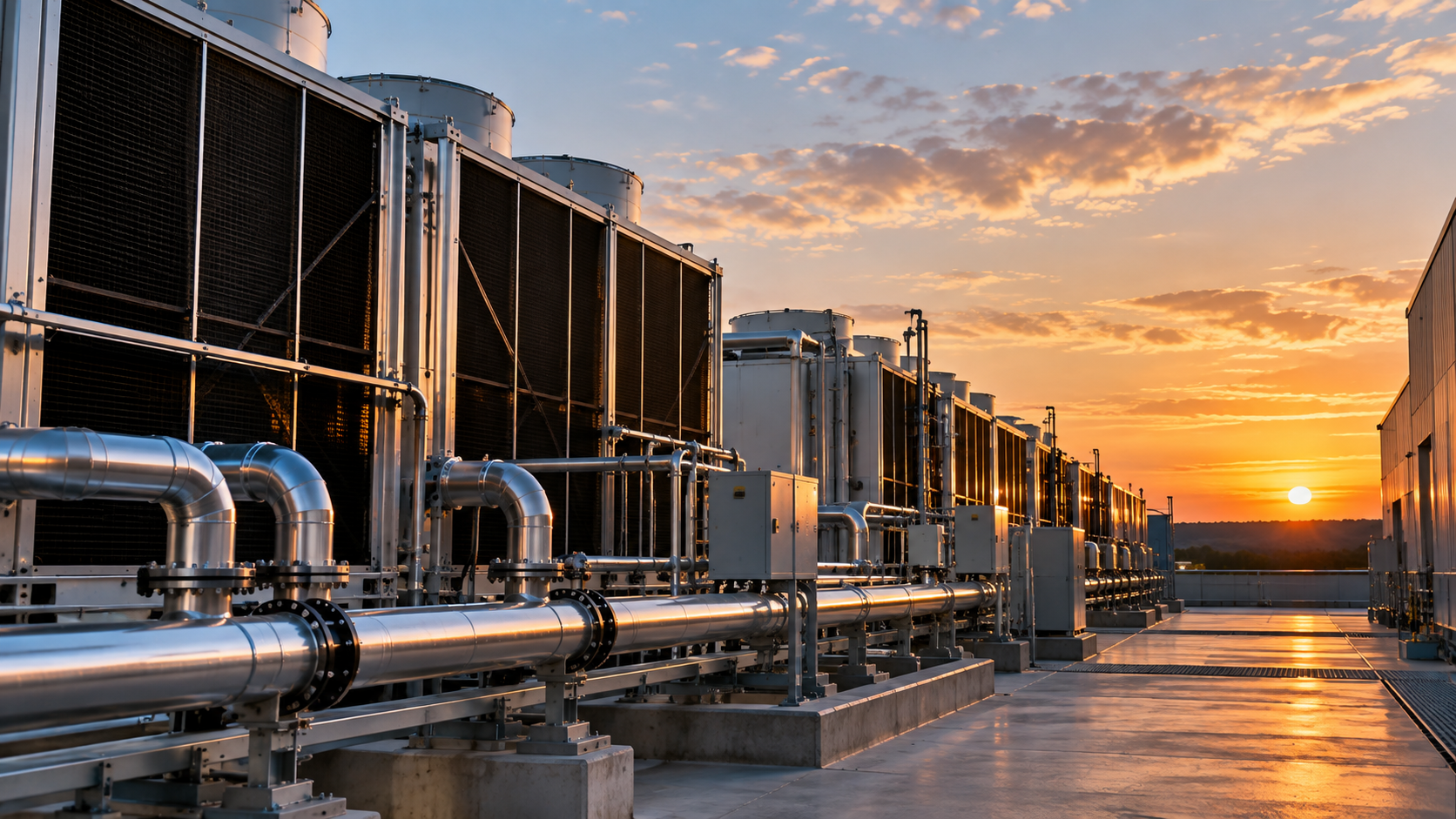
Artificial intelligence is rapidly becoming a physical infrastructure investment story. The enormous computing power required to train and operate advanced AI systems depends not only on semiconductors, electricity, and networking, but also on something far less visible: the ability to remove extraordinary amounts of heat.
For investors, that makes cooling an increasingly important part of the AI value chain.
As AI processors become more powerful and data centers become more densely packed, traditional cooling systems are approaching practical limits. The result is a significant infrastructure transition toward liquid cooling, advanced thermal management, and increasingly sophisticated power and environmental control systems.
Cooling may not attract the attention commanded by AI chips, but without it, those chips cannot operate efficiently at scale.
For long-term investors, this creates another example of how the AI investment opportunity is expanding beyond technology companies and into the industrial infrastructure required to support the next generation of computing.
The Hidden Infrastructure Behind AI
Modern AI workloads are dramatically different from traditional computing tasks.
Training large language models and operating advanced inference applications can require thousands of high-performance processors working continuously inside increasingly dense data centers.
As processor performance increases, so does heat generation.
The newest generation of AI accelerators can consume dramatically more power than conventional server processors. When thousands of these systems operate together, thermal management becomes one of the fundamental engineering constraints facing data center operators.
Historically, most data centers relied heavily on air-based cooling systems to regulate temperatures.
That architecture worked well for conventional enterprise computing, but the extraordinary power density associated with AI is changing the equation.
As server racks become more powerful, moving enough cool air through a facility becomes increasingly difficult and energy intensive.
That is pushing data center operators toward more advanced cooling technologies capable of removing significantly greater amounts of heat from increasingly concentrated computing environments.
Why Cooling Matters Financially
Cooling is more than an engineering problem.
It directly affects operating costs, equipment reliability, capital efficiency, and ultimately the economics of a data center.
Data centers already consume substantial amounts of electricity globally, and AI infrastructure is expected to increase that demand considerably.
A meaningful portion of a facility's electricity consumption can be associated with cooling and environmental control.
Improving thermal efficiency can therefore reduce operating expenses while allowing operators to deploy more computing capacity within a given amount of physical space.
That is particularly important because the economics of AI infrastructure increasingly depend on computing density.
If better cooling allows a data center to operate more processors within an existing facility, the operator may be able to increase computing output without expanding the building at the same rate.
In effect, better thermal management can help unlock additional productive capacity from expensive physical infrastructure.
That creates a powerful economic incentive for hyperscalers, cloud providers, and data center operators to invest in next-generation cooling systems.
Liquid Cooling Is Moving Toward the Mainstream
Liquid cooling is not a new technology.
It has been used for decades in specialized high-performance computing environments. What is changing is the scale at which it may now be required.
Liquids can absorb and transport heat much more efficiently than air, making liquid-based systems particularly well suited for high-density AI computing environments.
Several architectures are emerging.
Direct-to-chip cooling circulates liquid through specialized cold plates positioned directly on high-temperature components such as processors and accelerators.
Immersion cooling places computing equipment into specially engineered dielectric fluids capable of absorbing heat without damaging electronic components.
Rear-door heat exchangers use liquid-assisted cooling systems mounted behind server racks, providing an intermediate approach that can improve thermal performance without requiring an entirely new data center architecture.
Different applications may favor different technologies.
The broader investment point, however, is more important than predicting which specific architecture ultimately dominates.
As computing density increases, thermal management becomes increasingly valuable.
The Picks-and-Shovels Opportunity
The expansion of AI infrastructure is creating opportunities well beyond semiconductor manufacturers.
Advanced cooling systems require an extensive industrial supply chain.
That includes pumps, valves, heat exchangers, chillers, cooling distribution units, specialized fluids, sensors, industrial controls, electrical equipment, and sophisticated monitoring systems.
Engineering and construction companies also play an important role because many new AI data centers must be designed around dramatically higher power and cooling requirements.
This creates a classic picks-and-shovels investment opportunity.
Rather than attempting to predict which AI model, software platform, or semiconductor architecture ultimately dominates, investors can examine the businesses supplying infrastructure that many competing AI systems require.
At [Owls Nest Capital](/), this broader infrastructure perspective is an important part of evaluating long-term technological change.
The objective is not simply to identify the most visible beneficiaries of AI.
It is to understand the entire economic ecosystem developing around it.
The Energy Connection
Cooling cannot be separated from the broader energy requirements of artificial intelligence.
AI data centers require enormous amounts of electricity not only to operate processors but also to power networking equipment, storage systems, cooling infrastructure, and other supporting systems.
As hyperscale data centers expand, utilities in several major markets are confronting substantially higher electricity demand forecasts.
That makes efficiency increasingly valuable.
Every improvement in thermal management potentially reduces the amount of electricity required to remove heat while allowing operators to generate more computing output from available power.
This creates an important connection between several investment themes that may initially appear unrelated.
AI computing.
Electric utilities.
Power generation.
Transmission infrastructure.
Electrical equipment.
Industrial automation.
Data center construction.
And advanced cooling.
Increasingly, these industries are becoming interconnected components of the same infrastructure buildout.
Cooling May Become a Computing Constraint
One of the most important questions for investors is not simply how many AI chips companies can manufacture.
It is how many can actually be deployed economically.
A semiconductor sitting inside a data center requires electricity, networking, physical space, and thermal management before it can generate useful computing capacity.
Constraints in any one of those areas can potentially limit deployment.
That makes cooling capacity increasingly strategic.
As processor power requirements rise, data center design may become constrained not only by available electricity but also by the ability to remove heat efficiently.
Companies capable of solving those bottlenecks may therefore occupy increasingly valuable positions within the AI infrastructure supply chain.
Risks Investors Should Consider
The long-term growth opportunity does not eliminate investment risk.
Thermal management technology is evolving rapidly, and today's preferred architecture may not remain dominant indefinitely.
Companies that commit heavily to one technology could face competitive pressure if data center operators adopt alternative designs.
Capital spending cycles also matter.
Hyperscale cloud providers are currently investing enormous amounts of capital into AI infrastructure, but infrastructure spending rarely increases in a straight line. Periods of aggressive expansion can be followed by periods of slower investment.
Competition may also increase as the cooling opportunity becomes more visible.
Industrial equipment manufacturers, specialized cooling companies, engineering firms, and technology providers are all competing for positions within the emerging market.
Valuation remains equally important.
A strong industry does not automatically make every company within that industry an attractive investment.
Investors must still evaluate balance sheets, competitive advantages, management quality, cash flow generation, and the expectations already reflected in stock prices.
Looking Ahead
Artificial intelligence requires far more than advanced algorithms and increasingly powerful processors.
It requires an enormous physical ecosystem capable of supplying electricity, moving data, constructing facilities, and controlling heat.
Cooling is becoming one of the critical components of that ecosystem.
Without efficient thermal management, increasingly powerful AI processors cannot operate economically or reliably at scale.
For long-term investors, the broader lesson extends beyond cooling itself.
Major technological revolutions rarely create opportunity within only one industry. They create new infrastructure requirements, supply chains, bottlenecks, and engineering challenges.
Those challenges often create businesses that become essential to the growth of the technology even if they remain largely invisible to consumers.
As AI investment continues expanding, investors should monitor liquid cooling adoption, processor power density, data center construction, electricity demand, industrial equipment spending, and thermal management technology.
The companies solving these infrastructure constraints may ultimately become some of the most important picks-and-shovels businesses of the AI era.
The next generation of artificial intelligence will depend not only on how much computing power companies can build, but on how efficiently they can power it, connect it, and keep it cool.