
Gold, Silver and Portfolio Protection: What Investors Should Consider for 2027
Gold and silver have occupied an important place in the global financial system for thousands of years.
Long before modern stock exchanges, electronic banking, and digital currencies, precious metals served as stores of value, mediums of exchange, and symbols of financial security.
Today, their role has evolved.
Investors can purchase physical bullion, exchange-traded funds, mining company shares, and other financial instruments providing exposure to precious metals.
Yet the fundamental investment question remains remarkably consistent.
Can gold and silver help protect long-term wealth during periods of inflation, economic uncertainty, currency volatility, and financial market stress?
As investors prepare for 2027, that question deserves renewed attention.
Central banks continue to accumulate gold, geopolitical uncertainty remains an important market influence, and silver benefits from both investment demand and industrial applications.
However, precious metals are not risk-free.
Their prices can experience substantial volatility, they do not generate dividends, and their investment performance depends on economic conditions and market expectations.
For long-term investors, the objective should not be predicting the next dramatic price increase.
It should be understanding how precious metals may contribute to a diversified portfolio designed to preserve and grow wealth across economic cycles.
1. Why Gold and Silver Are Attracting Investor Attention
Several economic developments have increased interest in precious metals.
These include persistent inflation concerns, uncertainty surrounding monetary policy, geopolitical tensions, and the desire to diversify beyond traditional financial assets.
Gold has also attracted significant institutional and central bank demand.
According to the World Gold Council's November 3, 2026 Gold Demand Trends report, central banks and other official institutions purchased a net 321 metric tonnes of gold during the third quarter of 2026.
That represented a 42% increase compared with the same quarter in 2025.
Year-to-date central bank purchases reached approximately 675 tonnes.
Physically backed gold exchange-traded funds also experienced substantial inflows during the quarter.
These developments illustrate the continued importance of gold as a reserve asset and portfolio diversifier.
However, strong demand does not guarantee continued price appreciation.
When investor expectations become excessively optimistic, precious metals can experience sharp corrections.
2. Gold: A Traditional Store of Value
Gold differs from conventional financial assets.
A stock represents ownership in a business.
A bond generally represents a contractual debt obligation.
Gold does not provide ownership in a cash-generating enterprise or promise periodic interest payments.
Its value comes from scarcity, durability, global acceptance, industrial and jewelry applications, and investment demand.
Why Investors Own Gold
Gold is commonly held for several reasons.
Portfolio diversification
Gold's performance may differ from that of equities and bonds during certain market environments.
Currency risk
Gold is globally traded and may benefit when confidence in particular currencies weakens.
Financial uncertainty
Investors sometimes increase gold exposure during geopolitical crises or financial instability.
Long-term wealth preservation
Gold has maintained economic significance across centuries, although its purchasing power can fluctuate substantially over shorter periods.
Central bank reserves
Monetary authorities hold gold as part of their reserve management strategies.
These characteristics can make gold useful within a diversified portfolio.
However, investors should distinguish between gold's historical role and its future investment returns.
3. Central Bank Gold Buying: A Structural Source of Demand
Central banks are among the most important participants in the global gold market.
They hold gold alongside foreign currencies, government securities, and other reserve assets.
Central bank gold purchases may reflect several objectives.
These include reserve diversification, geopolitical risk management, and reducing dependence on specific foreign currencies.
What the 2026 Central Bank Survey Revealed
The World Gold Council's 2026 Central Banks Gold Reserves Survey reported that:
- 89% of surveyed reserve managers expected global central bank gold holdings to increase over the following 12 months.
- 45% expected their own institutions to increase gold reserves.
- 83% believed gold would represent a higher share of global reserves over the next five years.
These findings reflect survey expectations rather than guaranteed future purchases.
Nevertheless, they demonstrate the importance of gold within institutional reserve management.
Why Central Bank Demand Matters
Central banks can represent substantial sources of physical gold demand.
Their investment decisions may be influenced by long-term monetary and geopolitical considerations rather than short-term trading strategies.
However, central bank purchases can fluctuate, and changes in reserve policies may affect demand.
For investors, official-sector activity is one factor to monitor rather than a sufficient reason to purchase gold at any price.
4. Silver: A Precious Metal With an Industrial Identity
Silver shares several characteristics with gold.
Both are precious metals with established investment markets.
However, silver has a substantially greater connection to industrial demand.
Silver is used in electrical equipment, electronics, solar technology, automotive applications, and other manufacturing processes.
Its electrical conductivity and other physical characteristics make it valuable in specialized applications.
Why Silver Behaves Differently From Gold
Gold demand is heavily influenced by investment, jewelry, and central bank activity.
Silver demand is more closely connected to industrial production.
This creates two potential sources of demand.
First, investors may purchase silver as a precious metal.
Second, manufacturers require silver for industrial applications.
However, this dual role can also increase volatility.
During periods of economic weakness, industrial demand may decline even when investment demand for precious metals increases.
As a result, silver should not automatically be expected to perform like gold during financial crises.
5. The Silver Supply and Demand Outlook
The Silver Institute's 2026 research projected a sixth consecutive annual global silver market deficit.
Its February 2026 outlook estimated a deficit of approximately 67 million troy ounces for the year.
The same outlook projected global silver supply of approximately 1.05 billion ounces.
These estimates highlight the importance of supply and demand conditions.
However, a market deficit does not necessarily mean silver prices must rise.
Above-ground inventories, investment flows, recycling, and changes in industrial demand can influence market balances.
Industrial Demand and Technological Change
Several industries contribute to silver consumption.
These include:
- Solar energy
- Electronics
- Electrical equipment
- Automotive manufacturing
- Data center infrastructure
- Industrial machinery
However, higher silver prices can encourage manufacturers to reduce the amount of silver used in individual products.
This process is sometimes called thrifting.
Companies may also develop substitute materials or alternative manufacturing methods.
The Silver Institute has identified silver-saving technologies and substitution in photovoltaic applications as important factors influencing future industrial demand.
Therefore, investors should avoid assuming that growth in solar installations automatically produces equivalent growth in silver consumption.
6. Gold Versus Silver: Understanding the Differences
Although gold and silver are frequently discussed together, they serve different portfolio roles.
| Characteristic | Gold | Silver |
|---|---|---|
| Primary investment role | Monetary asset and portfolio diversifier | Precious metal and industrial commodity |
| Central bank demand | Significant | Limited |
| Industrial demand | Relatively smaller share | Significant |
| Price volatility | Often lower than silver | Often higher than gold |
| Economic sensitivity | Strong monetary and investment influences | Monetary and industrial influences |
| Storage efficiency | High value relative to weight | Lower value relative to weight |
| Income generation | None | None |
| Inflation protection | Variable across periods | Variable across periods |
For investors prioritizing capital preservation, gold may be more appropriate as a defensive allocation.
Silver may provide additional upside potential under favorable industrial and investment conditions.
However, that potential generally comes with greater price volatility.
7. Gold and Inflation: Does Gold Really Protect Purchasing Power?
Gold is frequently described as an inflation hedge.
The relationship is more complicated than the phrase suggests.
Over very long periods, gold has demonstrated an ability to preserve economic value.
However, its price does not increase consistently with consumer inflation.
Gold can decline during periods of elevated inflation.
It can also appreciate during periods when inflation is relatively low.
What Drives Gold Beyond Inflation?
Important factors include:
- Real interest rates
- U.S. dollar movements
- Central bank demand
- Investment flows
- Geopolitical uncertainty
- Financial market volatility
- Inflation expectations
Real Interest Rates
Real interest rates represent nominal interest rates adjusted for inflation expectations.
When real yields rise, interest-bearing assets can become more attractive relative to gold.
Because gold does not generate interest, higher real yields can increase the opportunity cost of holding it.
Conversely, falling real yields may support gold demand.
However, these relationships are not consistent in every market environment.
Gold's performance depends on multiple interacting factors.
8. Federal Reserve Policy and Precious Metals in 2027
Federal Reserve monetary policy may significantly influence precious metals markets.
Changes in interest rates affect borrowing costs, currency markets, and the relative attractiveness of income-producing investments.
Scenario One: Interest Rates Remain Elevated
If inflation remains persistent and the Federal Reserve maintains relatively high interest rates, gold may face competition from Treasury securities and other interest-bearing investments.
However, geopolitical uncertainty or financial instability could still support demand.
Scenario Two: Gradual Interest Rate Cuts
If inflation moderates and the Federal Reserve reduces rates, the opportunity cost of holding gold may decline.
This could create a more supportive environment for precious metals.
Scenario Three: Economic Recession
A recession could increase demand for defensive assets.
Gold may benefit from financial uncertainty and declining interest rates.
Silver could experience conflicting influences if industrial demand weakens.
Scenario Four: Strong Economic Expansion
A strong economy may support industrial silver consumption.
However, rising real yields or a stronger dollar could place pressure on precious metals valuations.
These scenarios illustrate why investors should avoid relying on one economic forecast.
9. The Gold-to-Silver Ratio: What Investors Should Understand
The gold-to-silver ratio measures how many ounces of silver are required to purchase one ounce of gold.
The calculation is straightforward.
Gold-to-Silver Ratio = Gold Price per Ounce / Silver Price per Ounce
For example, assume:
- Gold trades at $4,000 per ounce.
- Silver trades at $80 per ounce.
The ratio would be 50.
This means one ounce of gold has the same market value as 50 ounces of silver.
These prices are hypothetical examples, not current market quotations.
How Investors Interpret the Ratio
A relatively high ratio may indicate that silver is inexpensive compared with gold, based on historical relationships.
A relatively low ratio may suggest the opposite.
However, the ratio does not have a fixed fair value.
Industrial demand, investment flows, and supply conditions can change the relationship over time.
Investors should not assume the ratio must return to a particular historical average.
It is a comparative valuation indicator, not a reliable standalone trading signal.
10. Physical Gold and Silver: Direct Ownership of Precious Metals
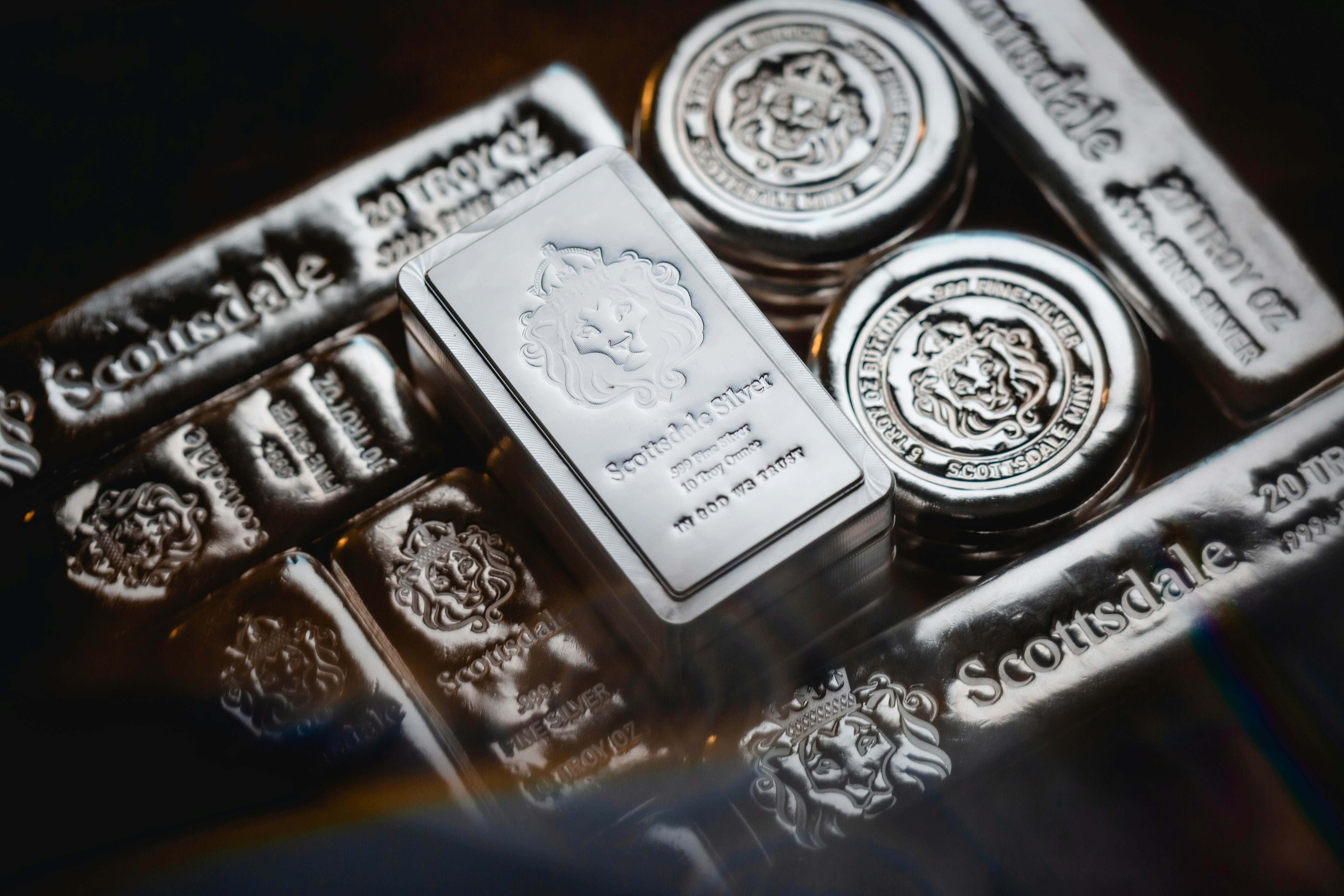
Investors can purchase physical gold and silver through coins, bars, and other bullion products.
Physical ownership provides direct exposure to the metal without relying on a fund structure.
However, it also creates practical considerations.
Advantages of Physical Bullion
Physical precious metals may provide:
- Direct ownership
- Independence from brokerage account operations
- Long-term tangible asset exposure
- Potential diversification from financial securities
Disadvantages of Physical Bullion
Important considerations include:
- Dealer premiums
- Storage expenses
- Insurance costs
- Theft risk
- Authentication requirements
- Transaction spreads
- Limited immediate liquidity compared with exchange-traded securities
Gold Versus Silver Storage
Gold generally offers greater value in a smaller physical volume.
Silver requires substantially more storage space for an equivalent dollar investment.
This distinction becomes important for larger allocations.
Purchasing Considerations
Investors should compare dealer premiums, buyback policies, product authenticity, and storage arrangements.
A reputable dealer and transparent pricing are essential.
11. Gold and Silver ETFs: A Convenient Alternative
Exchange-traded funds and trusts allow investors to obtain precious metals exposure through brokerage accounts.
These vehicles can simplify trading and eliminate the need for personal bullion storage.
However, their structures, fees, custody arrangements, and redemption provisions differ.
SPDR Gold Shares (GLD)
SPDR Gold Shares seeks to reflect the performance of gold bullion, less expenses.
It provides exchange-traded exposure to gold.
iShares Gold Trust (IAU)
iShares Gold Trust also provides exposure to gold bullion.
Investors should compare expenses, liquidity, and structure.
iShares Silver Trust (SLV)
iShares Silver Trust provides exchange-traded exposure to silver.
Its performance is influenced by silver prices and fund expenses.
abrdn Physical Precious Metals Basket Shares ETF (GLTR)
GLTR provides exposure to a basket of precious metals.
Its holdings can include gold, silver, platinum, and palladium.
Important ETF Considerations
Investors should evaluate:
- Expense ratios
- Fund structure
- Custody arrangements
- Liquidity
- Tracking differences
- Tax treatment
- Redemption provisions
Some precious metals trusts receive tax treatment different from conventional stock ETFs.
Investors should review fund documents and consult tax professionals when appropriate.
12. Gold and Silver Mining Stocks: A Different Investment Proposition
Mining companies provide another way to participate in precious metals markets.
However, mining shares are not equivalent to owning bullion.
Mining companies operate businesses with revenue, expenses, employees, capital requirements, and operational risks.
Their profitability depends partly on commodity prices.
Newmont (NEM)
Newmont is a major gold mining company with operations across multiple regions.
Its financial performance depends on production, operating costs, capital spending, commodity prices, and asset management.
Barrick Mining (B)
Barrick operates gold and copper mining assets.
Its investment performance depends on commodity markets, production costs, reserve quality, and project execution.
Agnico Eagle Mines (AEM)
Agnico Eagle operates gold mining assets and provides exposure to gold production.
Investors should evaluate production growth, operating margins, reserves, and valuation.
Pan American Silver (PAAS)
Pan American Silver operates precious metals mining assets with exposure to silver and gold.
Its performance depends on metal prices, production, costs, and operating conditions.
Wheaton Precious Metals (WPM)
Wheaton operates a precious metals streaming business.
Streaming agreements generally provide rights to purchase specified quantities of metals from mining operations under contractual terms.
This differs from directly operating mines.
However, streaming companies remain exposed to commodity prices and counterparties' operating performance.
Why Mining Stocks Carry Additional Risk
Mining companies face risks involving:
- Production interruptions
- Labor expenses
- Energy costs
- Environmental regulations
- Political instability
- Capital expenditures
- Reserve depletion
- Project development
- Financial leverage
Mining stocks can outperform bullion during favorable conditions.
They can also decline sharply even when precious metals prices remain relatively stable.
13. Gold Miners Versus Physical Gold
| Factor | Physical Gold | Gold Mining Stocks |
|---|---|---|
| Ownership | Direct metal ownership | Equity ownership |
| Operating business risk | None from mining operations | Significant |
| Dividend potential | None | Possible |
| Management risk | Limited to storage and counterparties | Significant |
| Commodity price exposure | Direct | Indirect and potentially amplified |
| Production costs | Not applicable | Important |
| Stock market correlation | Varies | Often more equity-sensitive |
| Financial leverage | None unless investor borrows | Company-dependent |
For portfolio protection, physical gold or bullion-backed vehicles may provide more direct exposure to gold prices.
Mining stocks are better understood as operating businesses influenced by precious metals markets.
14. Precious Metals and Portfolio Diversification
One of the strongest arguments for owning gold is diversification.
Different asset classes respond differently to economic developments.
Equities are influenced by corporate earnings, valuation, and economic growth.
Bonds are influenced by interest rates, inflation, and credit conditions.
Gold responds to monetary expectations, investment demand, currency movements, and geopolitical uncertainty.
These differences may help reduce overall portfolio concentration.
However, gold is not guaranteed to rise when stocks decline.
Correlations change over time.
During severe market stress, investors may sell gold alongside other assets to raise liquidity.
Therefore, gold should be viewed as a potential diversifier rather than a guaranteed hedge.
15. How Much Gold and Silver Should Investors Own?
There is no universal allocation appropriate for every investor.
The appropriate percentage depends on:
- Investment objectives
- Time horizon
- Risk tolerance
- Existing portfolio holdings
- Liquidity requirements
- Inflation concerns
- Income needs
- Tax considerations
Some diversified investors use modest precious metals allocations.
Others prefer no direct precious metals exposure.
Illustrative Allocation Scenarios
The following examples show how different allocations would translate into dollar amounts for a hypothetical $1 million portfolio.
| Precious Metals Allocation | Dollar Amount | Remaining Portfolio |
|---|---|---|
| 2% | $20,000 | $980,000 |
| 5% | $50,000 | $950,000 |
| 7.5% | $75,000 | $925,000 |
| 10% | $100,000 | $900,000 |
These are mathematical illustrations, not recommended allocations.
A larger precious metals allocation may increase exposure to commodity price volatility and reduce the percentage invested in income-producing assets.
Investors should evaluate portfolio-level risk rather than selecting a percentage based solely on historical gold performance.
16. A Practical Example of Portfolio Protection
Consider a hypothetical portfolio with the following allocation:
| Asset Class | Allocation |
|---|---|
| Equities | 60% |
| Bonds | 30% |
| Gold | 7% |
| Silver | 3% |
| Total | 100% |
Suppose the following hypothetical annual returns occur:
- Equities decline 20%.
- Bonds decline 5%.
- Gold increases 15%.
- Silver declines 10%.
The weighted portfolio return would be:
Equities: 60% × -20% = -12.0%
Bonds: 30% × -5% = -1.5%
Gold: 7% × 15% = +1.05%
Silver: 3% × -10% = -0.30%
Total portfolio return: -12.75%
Under these assumptions, the portfolio would still experience a meaningful loss.
However, the positive gold contribution would partially offset declines elsewhere.
This illustrates an important principle.
Portfolio protection does not necessarily mean eliminating losses. It means managing exposure to different sources of financial risk.
Actual market returns and correlations will vary.
17. Precious Metals Versus Dividend-Paying Investments
At Owls Nest Capital, recurring investment income is an important consideration.
This creates a fundamental distinction between precious metals and dividend-paying securities.
Gold and silver do not generate earnings or distributions simply by being held.
Dividend-paying companies may provide recurring income supported by operating cash flow.
Comparing the Two Approaches
| Factor | Gold and Silver | Dividend Stocks |
|---|---|---|
| Recurring income | None | Potential dividends |
| Capital appreciation | Possible | Possible |
| Business earnings exposure | None for bullion | Direct |
| Inflation protection | Variable | Potentially through earnings and dividend growth |
| Portfolio diversification | Potentially valuable | Depends on sector exposure |
| Income compounding | Not available directly | Possible through reinvestment |
| Primary risks | Commodity price volatility | Business, market, and dividend risks |
These investments serve different purposes.
Dividend-paying equities can support long-term income growth.
Precious metals may provide exposure to different economic and monetary risk factors.
A diversified portfolio may include both.
However, the allocation should reflect the investor's objectives rather than an assumption that precious metals will always outperform during uncertainty.
18. The Opportunity Cost of Holding Precious Metals
One of the most important considerations in precious metals investing is opportunity cost.
Gold and silver do not produce recurring cash flow.
A $100,000 investment in physical gold generates no interest or dividends.
By comparison, a hypothetical income-producing portfolio yielding 4% would initially generate $4,000 annually.
Over time, that income could be spent or reinvested.
However, income-producing investments carry their own risks, and distributions are not guaranteed.
The appropriate comparison must consider total return, volatility, liquidity, and the role each asset plays in the portfolio.
For long-term investors, precious metals should generally be evaluated as a diversification tool rather than a replacement for productive investments.
19. Three Precious Metals Scenarios for 2027
Rather than predicting specific gold and silver prices, investors may benefit from evaluating several economic scenarios.
Scenario One: Inflation Remains Elevated
Persistent inflation and uncertainty surrounding monetary policy could support demand for precious metals.
However, higher real interest rates may create opposing pressure.
Scenario Two: Interest Rates Decline
Falling real yields and a weaker dollar could support gold.
Silver may also benefit, particularly if industrial demand remains healthy.
Scenario Three: Strong Economic Growth
Industrial silver consumption may benefit from manufacturing expansion.
Gold could face pressure if investors favor risk assets and interest-bearing securities.
Scenario Four: Financial Market Stress
Gold may attract defensive investment demand.
Silver could experience greater volatility because of its industrial exposure.
These scenarios are not price forecasts.
Their purpose is to illustrate the different forces influencing precious metals.
20. What Investors Should Monitor in 2027
Several indicators may help investors evaluate the precious metals market.
Federal Reserve Policy
Interest rate expectations influence real yields and currency markets.
Central Bank Purchases
Official-sector gold demand can affect the balance between supply and investment demand.
U.S. Dollar Strength
Precious metals are commonly priced in dollars, making currency movements important.
Industrial Silver Demand
Solar manufacturing, electronics, automotive production, and data center infrastructure can influence silver consumption.
Mining Supply
Production trends, project development, and operating costs affect precious metals availability.
Recycling
Higher prices can encourage additional recycling supply.
ETF Investment Flows
Large inflows or outflows can influence investment demand.
Market Valuation and Sentiment
Strong price momentum can attract speculative investment, increasing the risk of sharp corrections.
Investors should examine these indicators collectively rather than relying on any single measure.
21. The Risks of Investing in Gold and Silver
Precious metals can contribute to diversification, but investors must understand their limitations.
Price Volatility
Gold and silver can experience significant market declines.
Silver is often especially volatile.
No Recurring Income
Physical metals and bullion-backed investment vehicles generally do not generate operating income.
Storage and Insurance
Physical ownership may require secure storage and insurance.
Transaction Costs
Dealer premiums, bid-ask spreads, and fund expenses reduce investment returns.
Market Timing Risk
Purchasing after substantial price increases can expose investors to corrections.
Currency Risk
Precious metals prices are influenced by global currency markets.
Mining Company Risk
Mining shares carry operational, financial, and geopolitical risks beyond the underlying metal price.
Tax Complexity
Physical precious metals and certain investment trusts may be subject to different tax treatment from conventional equities.
Investors should understand these considerations before establishing an allocation.
The Owls Nest Capital Perspective: Protecting Wealth Without Abandoning Growth
At Owls Nest Capital, our investment philosophy emphasizes diversification, long-term ownership, disciplined valuation, and the preservation and growth of family wealth.
We believe portfolio protection is an essential part of successful long-term investing.
However, protecting wealth does not mean avoiding productive assets or attempting to eliminate every form of market volatility.
It means constructing a portfolio capable of navigating different economic environments.
Precious metals can play a role within that framework.
Gold may provide exposure to monetary and geopolitical risk factors that differ from those influencing traditional equities and bonds.
Silver offers a combination of precious metal investment demand and industrial exposure.
However, these characteristics must be balanced against price volatility and the absence of recurring income.
For a family office focused on long-term wealth creation, income-producing assets remain important.
Dividend-paying equities, infrastructure businesses, real estate, and fixed-income investments can generate cash flow that supports reinvestment and future financial obligations.
Precious metals may complement these holdings by providing additional diversification.
We believe allocation decisions should be based on portfolio objectives, liquidity requirements, valuation, and long-term risk management.
The goal is not to speculate on the next dramatic increase in gold or silver prices.
It is to determine whether a measured precious metals allocation can improve the resilience of the overall portfolio.
At Owls Nest Capital, we believe preserving wealth requires balancing productive investments with thoughtful diversification and disciplined risk management.
Frequently Asked Questions About Gold and Silver Investing in 2027
Is gold a good investment for 2027?
Gold may provide portfolio diversification and exposure to monetary and geopolitical uncertainty.
However, its attractiveness depends on valuation, real interest rates, investor demand, and individual portfolio objectives.
Is silver a better investment than gold?
Silver may offer greater upside during favorable industrial and investment conditions.
However, it often experiences greater volatility.
Gold and silver serve different investment purposes.
Does gold protect against inflation?
Gold has historically preserved value over very long periods, but it is not a reliable short-term inflation hedge.
Its performance depends on real interest rates, currencies, investment demand, and other factors.
Why are central banks buying gold?
Central banks may purchase gold to diversify reserves, manage geopolitical risks, and maintain exposure to an internationally recognized reserve asset.
Should investors buy physical gold or gold ETFs?
Physical gold provides direct ownership but requires storage and security.
Gold ETFs and trusts provide convenient brokerage exposure but involve fund expenses and structural considerations.
Do gold and silver pay dividends?
Physical gold and silver do not generate dividends.
Certain mining companies may pay dividends, but their financial performance depends on operating results and commodity prices.
What is the gold-to-silver ratio?
The gold-to-silver ratio measures how many ounces of silver are required to purchase one ounce of gold.
It is calculated by dividing the gold price per ounce by the silver price per ounce.
How much gold should a diversified portfolio contain?
There is no universal allocation.
The appropriate percentage depends on investment objectives, risk tolerance, liquidity needs, and existing portfolio exposure.
Are gold mining stocks safer than physical gold?
Not necessarily.
Mining companies face operational, financial, environmental, and geopolitical risks.
Their share prices may be more volatile than physical gold.
Can silver benefit from artificial intelligence?
Silver is used in electronics and electrical applications associated with data centers and advanced technology.
However, AI-related demand is only one part of the silver market and does not guarantee higher prices.
Final Thoughts: Precious Metals as Part of a Long-Term Wealth Strategy
Gold and silver continue to occupy an important place in global investment markets.
Their appeal reflects concerns about inflation, monetary policy, geopolitical uncertainty, and the long-term preservation of purchasing power.
Gold provides exposure to an established monetary asset with significant central bank and investment demand.
Silver combines precious metal characteristics with substantial industrial applications.
Both may contribute to portfolio diversification.
However, neither offers guaranteed protection against market losses.
Their prices can fluctuate substantially, and neither physical metal generates recurring income.
For investors preparing for 2027, the most important consideration is how precious metals fit within a broader investment strategy.
A well-constructed portfolio should balance growth, income, liquidity, diversification, and risk management.
At Owls Nest Capital, we believe precious metals deserve consideration as one component of a disciplined long-term allocation.
They should complement rather than automatically replace productive investments.
The purpose of owning gold and silver should not simply be to profit from uncertainty. It should be to strengthen a portfolio's ability to preserve and grow wealth across changing economic conditions.
Long-term financial security is built through diversification, patience, sound investment decisions, and a clear understanding of risk.
Precious metals can contribute to that objective when used thoughtfully and at an appropriate allocation.
---
Research Sources
1. World Gold Council: Gold Demand Trends
2. World Gold Council: Central Bank Gold Reserves Survey 2026
3. World Gold Council: Gold Outlook 2026
4. Silver Institute: World Silver Survey 2026
5. Silver Institute: Global Silver Market Outlook 2026
6. U.S. Geological Survey: Gold Statistics and Information
7. U.S. Geological Survey: Silver Statistics and Information
8. Federal Reserve: Monetary Policy
9. U.S. Securities and Exchange Commission: Investor.gov
---
Disclaimer: This article is provided for informational and educational purposes only and does not constitute personalized investment, financial, legal, or tax advice. References to individual companies, securities, investment funds, and precious metals are for research and discussion purposes and should not be interpreted as recommendations to buy or sell investments. Precious metals can experience substantial price volatility, and historical performance does not guarantee future results. Investors should conduct independent research and consult qualified professionals when appropriate.
Owls Nest Capital
Investing in tomorrow, building today.