
Artificial intelligence has become one of the defining investment themes of the decade, but the conversation often revolves around software companies, semiconductor designers, and cloud providers. While those businesses remain critical, the next phase of AI growth may depend just as much on industries that have existed for generations.
Concrete, copper, electricity, construction, and industrial equipment are becoming essential components of the digital economy as companies race to build the physical infrastructure required to support advanced computing.
The AI revolution is no longer just about faster chips. It is about creating an entirely new industrial ecosystem capable of supplying enormous amounts of power, connectivity, cooling, and computing capacity.
For long-term investors, understanding these supporting industries may prove just as important as following the latest advances in artificial intelligence itself.
AI Is Becoming a Physical Infrastructure Story
Every major technological revolution has required a significant buildout of physical assets.
Railroads fueled industrial expansion in the nineteenth century. Highways supported the automobile economy. Fiber-optic networks helped enable the internet age.
Artificial intelligence appears to be following the same pattern.
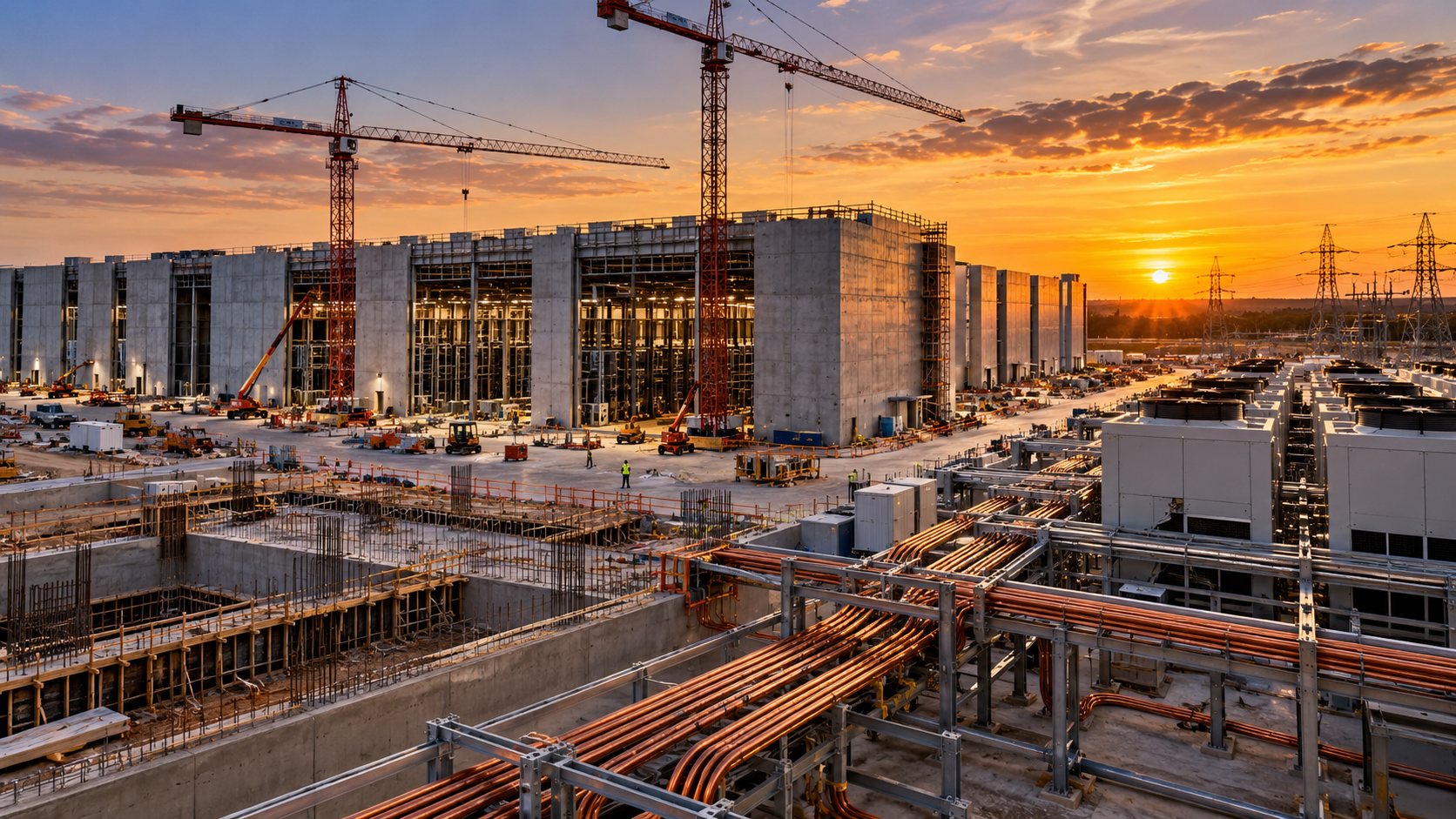
Major technology companies are committing enormous amounts of capital toward expanding AI infrastructure. New hyperscale data centers require vast quantities of land, reinforced concrete foundations, electrical equipment, cooling systems, backup power, and high-capacity transmission infrastructure before a single processor can begin performing AI workloads.
Unlike traditional office buildings, AI data centers are essentially industrial facilities designed to operate continuously while consuming substantial amounts of electricity.
That changes the investment landscape well beyond the technology sector.
As discussed in AI's Electricity Appetite, the expansion of artificial intelligence is increasingly becoming an energy story as much as a computing story. The infrastructure required to generate and deliver that electricity could become one of the defining investment themes of the coming decade.
Why Concrete Matters More Than Ever
Data centers are highly infrastructure-intensive construction projects.
The weight of server racks, backup power systems, cooling equipment, electrical infrastructure, and mechanical systems requires substantial foundations and structural support. Large hyperscale campuses can contain multiple buildings spread across hundreds of acres, creating significant demand for concrete, aggregates, steel, and other construction materials.
But AI is not the only source of infrastructure demand.
Governments continue investing in roads, bridges, manufacturing facilities, electrical grids, and energy infrastructure. At the same time, companies are expanding semiconductor plants, battery factories, logistics facilities, and data centers.
That combination creates multiple sources of demand for construction materials rather than relying on a single industry.
Historically, major infrastructure investment cycles can extend for years because large projects require extensive planning, permitting, engineering, construction, and expansion.
Concrete manufacturing may appear to be a mature industry, but mature industries can become strategically important when new technologies require enormous amounts of physical infrastructure.
AI may be creating exactly that environment.
Copper Is Becoming the Digital Metal
If semiconductors serve as the brains of artificial intelligence, copper functions as part of its circulatory system.
Every data center requires extensive electrical wiring, transformers, switchgear, cooling equipment, power distribution systems, and connections to the broader electrical grid.
Outside the facility, utilities may need to expand substations, transmission lines, and generation capacity to accommodate large new sources of electricity demand.
Copper sits at the center of much of this infrastructure.
Global copper demand is also being supported by electric vehicles, renewable energy projects, grid modernization, industrial automation, and broader electrification.
Artificial intelligence adds another potentially significant source of consumption.
The challenge is that expanding copper production is difficult.
Large mining projects can require many years of exploration, permitting, financing, construction, and development before meaningful production begins. Ore grades, environmental requirements, political risks, and rising development costs can further constrain new supply.
If electricity infrastructure and data center construction continue expanding rapidly, copper could become one of the critical materials connecting the digital and industrial economies.
Computing Requires More Than Chips
Semiconductors remain essential to artificial intelligence, but processors cannot create value without the infrastructure surrounding them.
Every graphics processing unit installed inside a server depends on reliable electricity, cooling systems, networking equipment, backup power, transformers, and physical facilities engineered for continuous operation.
Building a modern AI campus increasingly resembles constructing a power-intensive industrial facility rather than simply assembling a technology office.
Connectivity is equally important.
As explored in Fiber Optics: The Nervous System of AI, massive amounts of data must move rapidly between processors, servers, data centers, and users. High-speed fiber networks are therefore becoming another critical layer of the AI infrastructure stack.
This broader perspective helps explain why utilities, engineering firms, industrial manufacturers, electrical equipment suppliers, construction companies, and building-material producers have all become participants in the AI economy.
The processors may receive most of the attention, but they represent only one component of a much larger system.
Power May Become the Ultimate Constraint
Perhaps the most important infrastructure question surrounding artificial intelligence is whether electricity supply can expand quickly enough to support the growth of computing.
AI data centers require large amounts of dependable power, and new facilities can place significant demands on regional electrical grids.
Utilities therefore may need to expand generation capacity, transmission networks, substations, transformers, and other electrical infrastructure.
That possibility raises an increasingly important investment question: Will Utilities Become AI Stocks?
Utilities traditionally have been viewed as defensive investments characterized by regulated earnings and dividends. But the growth of data centers could create a new source of long-term electricity demand in selected markets.
The search for dependable electricity is also renewing interest in energy sources capable of supplying power around the clock.
Nuclear energy has become part of that conversation. In Nuclear Power's AI Revival, we examined why the enormous electricity requirements associated with AI infrastructure are encouraging technology companies, utilities, and investors to reconsider nuclear generation.
The relationship between computing and energy may ultimately become one of the most consequential developments of the AI era.
Where Investors May Find the Opportunities
The investment opportunity surrounding AI infrastructure extends across several layers of the economy.
Building-material producers supply the concrete, aggregates, and structural materials required for data center construction. Copper miners provide one of the most important raw materials for electrification. Electrical equipment manufacturers produce transformers, switchgear, power-management systems, and other components necessary to move electricity safely and reliably.
Engineering and construction companies design and build the facilities. Utilities provide generation and transmission capacity. Fiber-optic and networking companies move enormous quantities of data between computing systems.
Even cooling technology has become increasingly important as more powerful processors generate greater amounts of heat.
Together, these industries form the physical foundation of artificial intelligence.
For investors, this creates an alternative way to participate in the AI investment cycle.
Rather than attempting to predict which AI application, software platform, or semiconductor architecture will ultimately dominate the market, investors can also examine the companies supplying infrastructure that many competing AI platforms will require.
This is the classic "picks and shovels" approach to investing.
During major technological transformations, some of the most durable businesses are not necessarily the companies receiving the most attention. They may instead be the companies supplying essential equipment, materials, energy, and infrastructure to everyone participating in the expansion.
Opportunities Come With Risks
The growing demand for AI infrastructure creates opportunities across multiple sectors, but strong investment themes do not eliminate risk.
Infrastructure projects are capital intensive and frequently encounter cost overruns, permitting delays, labor shortages, supply-chain constraints, and changing economic conditions.
A slowdown in corporate capital spending or weaker-than-expected AI adoption could delay construction schedules.
Commodity markets are also cyclical.
Copper prices can fluctuate significantly based on global economic growth, geopolitical developments, currency movements, and industrial production. Mining companies face additional risks involving project development, operating costs, environmental regulations, and political stability.
Construction-material companies can be affected by energy costs, transportation expenses, housing and commercial construction cycles, and environmental requirements.
Utilities face their own challenges. Building new generation and transmission infrastructure requires substantial capital, and regulators ultimately influence how much of those investments can be recovered through customer rates.
Valuation deserves equal attention.
Some companies associated with AI infrastructure may experience significant share-price appreciation as investors anticipate future growth. A powerful long-term trend does not automatically make every company participating in that trend an attractive investment at every price.
Business quality, balance-sheet strength, competitive advantages, cash generation, valuation, and management execution remain essential considerations.
Looking Beyond the Headlines
Financial markets naturally focus on the companies producing the most visible technological innovations.
Yet history repeatedly demonstrates that major technological revolutions require enormous supporting infrastructure.
Artificial intelligence will require more than advanced software algorithms and increasingly powerful chips.
It will require concrete to build facilities.
Copper to carry electricity.
Fiber to move data.
Power plants and electrical grids to provide energy.
Cooling systems to control heat.
Engineering expertise to connect everything together.
For investors, this represents an important shift in perspective.
The AI economy is not solely a technology story. It is increasingly an infrastructure story spanning manufacturing, construction, utilities, industrial engineering, materials, telecommunications, and energy.
The companies laying foundations, expanding electrical grids, producing critical materials, and supplying industrial equipment may not receive the same attention as leading AI software and semiconductor companies.
Nevertheless, they are helping build the physical backbone of the next generation of computing.
At Owls Nest Capital, we believe long-term investing requires looking beyond short-term market narratives and understanding the businesses and infrastructure supporting structural economic change.
As the AI investment cycle continues to evolve, investors may want to look beyond the processors inside the data center and examine the industries making those processors useful in the first place.
In the years ahead, concrete, copper, and computing may prove to be three of the most important building blocks of the digital economy.